
First Aid Training for Offices and Corporate Workplaces
First Aid Training for Offices and Corporate Workplaces
Office work is often described as low risk, but low risk does not mean no risk. A medical emergency can happen in a boardroom, reception area, canteen or open-plan office just as easily as it can in a warehouse or on a construction site. Someone may collapse unexpectedly, experience chest pain, have a seizure, choke during lunch, suffer a serious allergic reaction or simply trip on a staircase and sustain an injury.
For Irish employers, first aid planning is therefore an important part of workplace health and safety. The aim is not to turn office staff into medical professionals. It is to make sure suitable people are trained to recognise an emergency, provide appropriate initial assistance and support a casualty until professional medical help arrives.
For businesses in Dublin and across Ireland, a sensible first aid programme should reflect the actual workplace: employee numbers, hybrid working arrangements, office layout, visitor levels, working hours and the availability of trained staff. This guide explains what corporate employers should consider when arranging First Aid Responder training and how to build reliable first aid cover without unnecessarily disrupting normal operations.
1. Why Offices Still Need Proper First Aid Arrangements
A modern office may not contain heavy machinery or obvious industrial hazards, but employees can still become injured or seriously unwell during the working day. Slips and trips, cuts, burns in kitchen areas, falls on stairs and minor musculoskeletal injuries are all possible. More importantly, workplaces must also be prepared for sudden medical emergencies that have nothing to do with the employee's job.
Cardiac arrest is a clear example. It can happen without warning and requires an immediate response. Having colleagues nearby who understand CPR and how to use an AED can be extremely important while emergency medical assistance is on the way. Other situations, including choking, seizures, asthma attacks and severe bleeding, can also require prompt action.
First aid arrangements also provide reassurance. Employees should know that if something happens at work there is a clear procedure, suitable equipment and someone available who has received appropriate training. This creates a more organised response and reduces the likelihood of confusion during an already stressful situation.
For employers, first aid should therefore be viewed as part of normal workplace preparedness rather than something relevant only to traditionally high-risk industries.
2. Start With a Workplace First Aid Risk Assessment
The right level of first aid cover depends on the circumstances of each organisation. A small professional office with eight employees will not necessarily require the same arrangements as a corporate headquarters with several hundred people across multiple floors. This is why employers should begin by assessing their workplace rather than simply choosing an arbitrary number of first aiders.
Consider how many people are normally present, including employees, contractors and visitors. Look at the layout of the building and whether teams are spread across separate floors, buildings or departments. A trained responder on the ground floor may not provide practical cover for staff several floors away if access is restricted or the building is particularly large.
Working patterns matter too. Hybrid working has changed office occupancy considerably. A company may employ 100 people but have only 40 present on a typical day, while Tuesdays and Thursdays may be substantially busier. First aid cover should reflect when people are actually in the workplace and should not disappear because the only trained responder happens to be working remotely.
Employers should also consider business travel, annual leave, sickness and meetings away from the office. Training several suitable employees usually provides much more resilient cover than relying on one person.
3. First Aid Responder Training for Corporate Staff
First Aid Responder training gives nominated employees practical skills for dealing with common first aid emergencies. The training typically covers areas such as patient assessment, CPR, AED use, choking, bleeding, shock, burns, injuries and a range of medical emergencies. Participants learn both what action to take and how to approach an incident safely.
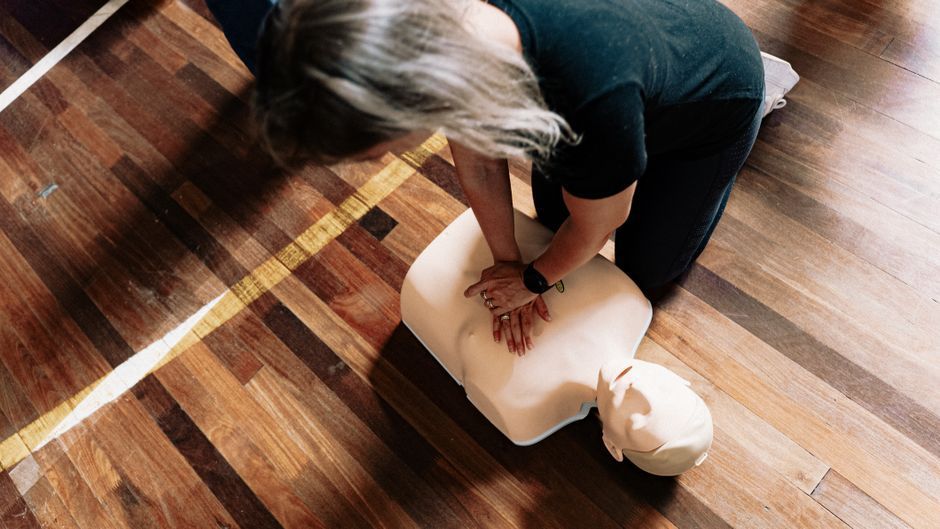
For office employees, practical confidence is particularly valuable. Many participants have never dealt with a real emergency before. Reading an emergency procedure is very different from kneeling beside a casualty, assessing responsiveness and deciding what to do next. Practical training allows people to rehearse those decisions in a controlled environment.
Corporate workplaces also benefit when responders understand how their training connects with internal procedures. Who calls emergency services? Who meets the ambulance? Where is the AED? How is reception informed? Which entrance gives paramedics the quickest access? These practical details can be incorporated into workplace planning alongside formal first aid training.
A good response depends on both individual skills and an organised system. Training employees without reviewing the wider emergency process can leave unnecessary gaps.
4. How Many Trained Responders Should an Office Have?
There is no useful universal figure that applies to every office. The appropriate number should follow from the workplace assessment and should provide realistic cover whenever employees are present. Employers should think in terms of availability rather than simply counting certificates.
For example, an organisation might have three trained responders on paper, but if all three work in the same department and regularly attend external meetings together, the actual level of cover may be poor. Similarly, a multi-floor office should consider whether trained responders are distributed sensibly throughout the building.
Absence cover is another important consideration. Annual leave, sickness, remote working and staff turnover can quickly reduce the number of trained people available. Training additional employees provides resilience and avoids the situation where an organisation suddenly discovers that nobody qualified is present.
It is also sensible to review the arrangement whenever the business changes. Moving office, expanding the workforce, adding another floor or introducing new shift patterns may all alter first aid needs.
5. Choosing the Right Employees for Training
The most suitable First Aid Responders are not necessarily the most senior employees. Availability, willingness and temperament are often more important. A good candidate should be comfortable taking responsibility, able to remain reasonably calm under pressure and willing to practise the skills required.
Office managers, reception staff, facilities teams and employees who are regularly present can make strong candidates because they often understand the building and know how to coordinate assistance. However, businesses should avoid placing all responsibility on one role or department.
Distribution matters. In a larger workplace, selecting responders from different teams or floors helps ensure someone is reasonably close when assistance is needed. Hybrid working patterns should also influence the decision. Employees who are in the office most days may provide more dependable cover than people who work remotely for much of the week.
Most importantly, staff should be willing participants. First aid involves close contact with casualties and potentially stressful situations. Selecting employees who genuinely want to undertake the role usually leads to better engagement and confidence.
6. AEDs and Cardiac Emergency Preparedness
Many Irish offices now have an automated external defibrillator, commonly known as an AED. Installing one is valuable, but the device should form part of a wider emergency response plan. Employees need to know where it is located, how to access it quickly and who should retrieve it during an emergency.
First Aid Responder training helps employees become familiar with CPR and AED use so that the equipment is less intimidating when urgently required. In an emergency, hesitation can waste valuable time. Familiarity developed through practical training can make the response more structured.
Businesses should also consider AED visibility and accessibility. A device hidden inside a locked office or placed somewhere employees cannot easily identify is less useful. Its location should be clearly communicated during staff induction and emergency briefings.
Regular checks should form part of workplace procedures so the organisation knows that equipment is ready for use. Responsibility for these checks should be clearly assigned rather than assumed.
7. First Aid Arrangements in Multi-Tenant Office Buildings
Many Dublin companies operate from shared office buildings, business centres and managed corporate developments. These environments can create additional questions about responsibility. A building may have reception staff, security personnel or an AED in a common area, but an employer should not automatically assume that these arrangements fully meet the needs of its own employees.
Companies should establish what building-wide emergency arrangements exist and how they interact with their own procedures. For example, reception may be responsible for directing an ambulance, while the employer's trained responder provides immediate assistance to the casualty.
Access is particularly important. Employees should know which entrance emergency services will use, whether lifts can be used during an incident and how security doors are opened. On upper floors, delays caused by access confusion can be avoided through simple planning.
Where several businesses share a workplace, communication between occupiers and building management can strengthen overall preparedness. However, each employer should still assess whether its own first aid arrangements are appropriate for its workforce.
8. Visitors, Clients and Members of the Public
Corporate first aid planning should not focus solely on employees. Many offices regularly receive clients, suppliers, interview candidates, contractors and other visitors. Reception areas and meeting rooms can therefore become the location of a medical emergency involving someone who does not know the building.
Reception and front-of-house staff should understand how to contact a trained responder quickly. Visitor sign-in procedures can also help determine who is present in the building if an incident occurs.
Businesses with particularly high visitor numbers may need to consider this when assessing first aid provision. A training centre, professional services office with frequent client meetings or large corporate headquarters can have considerably more people on site than its employee headcount alone suggests.
Clear procedures allow staff to respond consistently whether the casualty is an employee, contractor or visitor.
9. Maintaining Training and First Aid Records
First aid arrangements should be reviewed rather than treated as a once-off project. Staff change roles, employees leave, offices expand and certificates reach renewal dates. Without a simple monitoring system, a business can gradually lose the cover it originally established.
Keep a record of trained First Aid Responders and relevant training dates. Responsibility for monitoring renewals should be assigned to a specific person or department, such as HR, facilities or health and safety management. Planning refresher training before it becomes urgent makes maintaining cover much easier.
First aid kits should also be inspected regularly. Items used during an incident need replacing, and supplies should remain appropriate for the workplace. Employees should know where kits are located rather than relying on a responder to find them during an emergency.
When organisational changes occur, revisit the risk assessment. A company moving from one small office to three floors in a larger building should not simply carry its old first aid arrangement into the new workplace without review.
10. Why On-Site Training Works Well for Corporate Teams
On-site first aid training can be particularly convenient for office and corporate employers. Instead of sending individual employees to different public courses, businesses can train a group together at their own premises. This reduces travel and can make scheduling easier.
Training colleagues together also supports a more coordinated response. Participants learn the same procedures and can discuss practical issues specific to their workplace, including AED location, emergency access and communication between departments.
For larger organisations, group training can form part of a structured health and safety programme. New responders can be trained as staffing changes, while refresher courses can be planned in advance to maintain continuity.
Most importantly, practical first aid training gives employees confidence. Nobody can predict when a colleague will become seriously ill or injured. Knowing that trained people are present, and that they have practised what to do, creates a safer and better-prepared workplace.
Conclusion
Office workplaces may generally be lower risk than construction sites or industrial environments, but serious medical emergencies can occur anywhere. Irish employers should therefore make first aid provision part of their wider workplace safety arrangements and ensure that trained people are genuinely available when staff are present.
The right approach starts with assessing the workplace, choosing suitable employees, providing recognised First Aid Responder training and maintaining reliable cover across holidays, hybrid working and staff changes. Equipment, AED access and clear emergency procedures should support that training.
Handle with Care provides professional workplace first aid training for offices, corporate organisations and employers throughout Dublin and across Ireland. If your organisation needs First Aid Responder training, refresher training or an on-site course for a group of employees, contact Handle with Care to discuss a practical training solution for your workplace.